

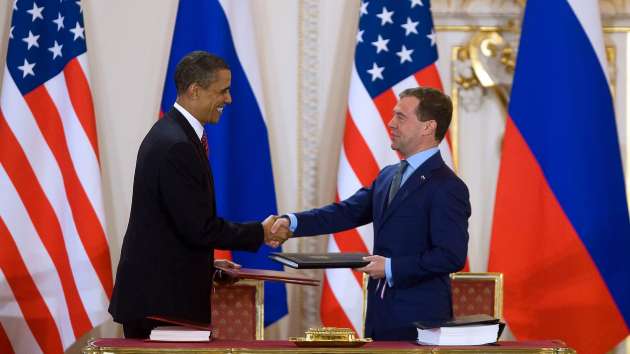
(WASHINGTON) — The historic treaty binding the U.S. and Russia to limit their deployment of the world’s most dangerous nuclear weapons lapsed overnight with no clear indication from Washington or Moscow on whether new talks would take place.
President Donald Trump, who in September appeared to be warming to the idea of renewing the treaty, backtracked last month, saying he would be comfortable allowing it to expire and hoped any new agreement would involve other parties.
“You probably want to get a couple of other players involved, also,” Trump told the New York Times.
Secretary of State Marco Rubio said Wednesday that any new arms control pact should include China, even though Beijing’s nuclear stockpile is dramatically smaller than that of the U.S. and Russia and any ceiling a deal might set would not be symmetrical to China’s arsenal.
“The president’s been clear in the past that in order to have true arms control in the 21st century, it’s impossible to do something that doesn’t include China, because of their vast and rapidly growing stockpile,” Rubio said.
Dmitry Peskov, the spokesperson for Russian President Vladimir Putin, confirmed the agreement was expiring Thursday.
“We view this negatively and regret this development,” he said, adding an offer from Putin to extend the deal went unanswered.
Chinese Foreign Ministry spokesperson Lin Jian said his country would not take part in a trilateral arrangement.
“The nuclear forces of China and the U.S. are not on the same level at all, and it is neither fair nor reasonable to ask China to join the nuclear disarmament negotiations at this stage,” he said.
Last remaining arms control agreement
The New START treaty, which was struck between President Barack Obama and Russian President Dmitry Medvedev in 2010 and went into effect the following year, was the last remaining arms control pact in force between the two nations, limiting the deployment of nuclear-capable weapons systems like intercontinental ballistic missiles and bombers — and placing a limit on the number of nuclear warheads which could be activated.
The U.S. and Russia have remained under the numeric limits of the treaty, whose “whole value” is “to have predictability between the United States and Russia,” said Rose Gottemoeller, a former State Department official who served as America’s chief negotiator on New START.
The U.S. has accused Russia of violating the treaty after Moscow suspended inspection and verification mechanisms during the COVID-19 pandemic, but Washington never accused the Russians of failing to adhere to the limits.
“The fact of the legally binding treaty limits [itself] has placed the brakes on any Russian attempt to build up the deployed systems,” said Gottemoeller, adding the U.S. has intelligence capabilities to unilaterally understand whether Russia is breaking promises under the treaty.
In September, Russian President Vladimir Putin offered the U.S. a one-year extension of New START, which Trump initially called a “good idea.”
But the U.S. never officially responded, according to Yuri Ushakov, Putin’s foreign policy aide.
In a statement to ABC News, The White House said that “the President will decide the path forward on nuclear arms control, which he will clarify on his own timeline.”
Russia and China have demonstrated increasing nuclear capabilities in recent years, a NATO official told ABC News. For its part, Russia has adopted a “posture of strategic intimidation” in its nuclear rhetoric, the official added.
Putin has flexed Russia’s muscles on nuclear arms over the past year, touting emerging technologies like its Poseidon system, a nuclear-armed and nuclear-propelled torpedo that travels underwater. Tactical nuclear arms like the Poseidon system were not covered by New START’s provisions.
“Restraint and responsibility in the nuclear domain is crucial to global security,” the NATO official said.
A “handshake” agreement?
Putin’s offer in the fall amounted to what would be a “handshake between the two presidents to preserve the limits of the treaty” even after the treaty itself formally expired, said Gottemoeller, who was under secretary of state for arms control and international security when the deal was originally struck and later became NATO’s deputy secretary general.
While the administration has pointed to China as a reason to forgo New START in favor of a broader deal, Gottemoeller said a one-year stopgap deal would actually help the U.S. pursue its arms control agenda with Beijing.
A one-year extension “makes sense for one very important reason,” she said. “We need to keep the Russians under control over the coming year, while we try to plan and prepare for what we’re going to do to respond to the … Chinese nuclear buildup.”
Gottemoeller and Lynn Rusten, another former U.S. official who helped negotiate the New START treaty, told ABC News a trilateral deal with the Chinese would not make practical sense, since China’s 600 nuclear-capable weapons are dwarfed by Russian and American stockpiles that are each more than 4,000.
A Pentagon report in December assessed the Chinese stockpile could rise to more than 1,000 in 2030.
The State Department did not respond to an inquiry about diplomatic channels for new arms control agreements with either Beijing or Moscow.
The president, who said he had an “excellent” call Wednesday with Chinese President Xi Jinping, did not say whether nuclear arms were mentioned.
Change won’t be immediate
The early days of a world without the last remaining treaty limiting the world’s largest nuclear powers will not be immediately changed, the former officials said.
“I don’t think we’re going to wake up tomorrow and be in a completely different world,” said Rusten, who led the U.S. government’s interagency process during talks over New START. “But I do think there’s going to be some mirror imaging. So if one country starts to build up its forces beyond New START limits, the other is almost sure to follow.”
The U.S. will have to “plan and prepare” for the reality after New START, given the Russians have more experience and defense capacity — including “hot warhead production lines” in support of its war in Ukraine, said Gottemoeller.
Rusten said the U.S.’s understanding of Russia’s arsenal will “atrophy,” a risk over the long run.
“Over time, we’re going to have a less and less precise picture of exactly how many Russian nuclear forces there are and where they are,” she said.
The U.S. and Russia — and the U.S. and the Soviet Union before that — cooperated on arms control for decades, managing to carve out the issue from other diplomatic issues which frayed the rivals.
In a statement marking the end of New START, the Center for Arms Control and Non-Proliferation said decades of diplomacy between Washington and Moscow “helped reduce the global nuclear arsenal by more than 80% since the height of the Cold War.”
“Now,” the statement said, “both Russia and the United States have no legal obstacle to building their arsenals back up, and we could find ourselves reliving the Cold War.”
Copyright © 2026, ABC Audio. All rights reserved.


