

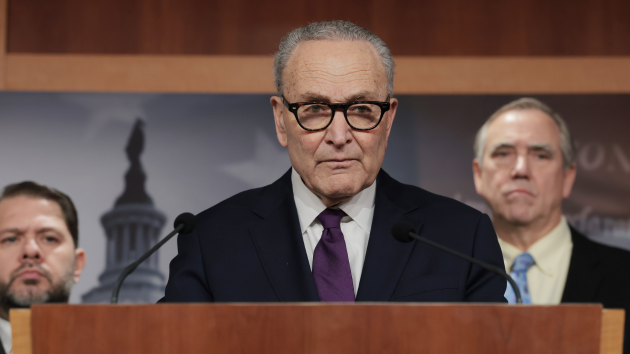
(WASHINGTON) — The Senate will vote Wednesday on a Democratic-led Iran war powers resolution, according to a press release from Minority Leader Chuck Schumer and bill co-sponsors Sens. Tim Kaine and Adam Schiff.
The resolution would direct the removal of United States armed forces from hostilities within or against Iran that have not been authorized by Congress. It comes after recent U.S. strikes on Iran that killed several Iranian leaders, including Ayatollah Ali Khamenei, the supreme leader of Iran.
There is no timeline in the bill, so if it passed and President Donald Trump signed it, the U.S. would have to draw down troops.
Because this bill is privileged, it would only need 51 votes to advance and ultimately be approved by the Senate. It’s not yet clear whether the legislation will have that support, but at this time it seems unlikely to advance.
Earlier this year, a similar resolution concerning military action in Venezuela passed an initial procedural test vote when a small handful of Republican senators voted with Democrats to move it forward. Some of those Republicans were ultimately swayed to revoke their support for that legislation during a vote on final passage, and the bill was ultimately defeated by Vice President JD Vance’s tie-breaking vote.
This time around though, Republicans seem even more inclined to support Trump’s actions in Iran.
Republican Sen. Josh Hawley, of Missouri, was one of the Republicans who initially supported the Venezuela war powers resolution before ultimately voting against it during a vote of final passage. His switch in position during that vote in January came after Trump attacked Hawley and the other Republicans who initially supported the proposal in a post on social media.
Hawley told ABC News on Tuesday that he would vote against the Iran war powers resolution.
The legislation cites the 1973 War Powers Resolution, which states that in the absence of a declaration of war but when armed forces are introduced, the president must report to Congress within 48 hours the circumstances necessitating their introduction and must terminate the use of U.S. armed forces within 60 days unless Congress permits otherwise. If approval is not granted and the president deems it an emergency, then an additional 30 days are granted for ending operations.
“I think they’re in compliance with the statute. The statute gives them 60 days, gives the administration 60 days to conduct activity without having to come back to … Congress for authorization, unless they’re ground troops. My view has always been, ground troops will require congressional authorization. So they’re currently none involved, none have been involved, and they’re following the War Powers Act,” Hawley said.
Still, Democrats say the vote is critical. Sen. Kaine, of Virginia, who is leading the Iran resolution and who has been an outspoken proponent of Congress’ role in declaring war, said the vote will show where everyone stands on the conflict.
“We’re going to put everybody on the record [Wednesday]. Nobody gets to hide and give the president an easy pass or an end run around the Constitution,” Kaine said on Tuesday. “Everybody’s got to declare whether they’re for this war or against it.”
Without the support of at least a few Republicans, the Iran resolution is likely to fail to advance during Wednesday’s vote.
Even if this legislation were to pass, it would still require approval in the House and the signature of the president to become law. It is highly unlikely Trump would sign the bill should it make it to his desk.
Copyright © 2026, ABC Audio. All rights reserved.


