

(NEW YORK) — There is evidence that the planet is healing amid massive efforts to mitigate climate change and fight biodiversity loss.
Once-threatened species are rebounding, lawmakers are making policy changes that increase protections against harmful practices and preservation of ecosystems has come to the forefront, according to recent events.
The wins, however, don’t cancel out the realities that the planet continues to be on a tipping point. The world is currently off track to meet the goal outlined in the 2015 Paris Agreement to limit global warming to 1.5 degrees Celsius, according to the United Nations.
The planet has entered an era of “water bankruptcy,” due to irreversible damage to water systems, according to the U.N.’s University Institute for Water, Environment and Health. Deforestation is continuing to occur at a rapid rate, including 16.6 million acres of tropical primary forests lost in 2024 – equivalent to 18 soccer fields per minute, according to the World Wildlife Fund.
Despite the losses, recent environmental wins prove that efforts to protect the planet and its inhabitants are working.
Threatened species are recovering
Most sea turtles are rebounding worldwide as a result of conservation, according to the National Oceanic and Atmospheric Administration.
Green turtles made an especially notable recovery. Once hunted to near-extinction for their eggs – used to make turtle soup – green turtle populations have risen significantly since the 1970s, according to the International Union for Conservation of Nature’s 2025 update to its Red List of Threatened Species. Their status was downgraded from endangered to least concern.
Global conservation efforts included protecting eggs, releasing hatchlings on beaches and reducing capture in fishing nets, according to the IUCN.
Endangered Central California coast coho salmon are returning to Central California’s Russian River after decades of absence – an indicator of river restoration. During the 2024 to 2025 spawning season, more than 30,000 adult coho salmon migrated to the rivers along the Mendocino Coasts – double the record-breaking number of 15,000 seen in the previous season, according to NOAA Fisheries.
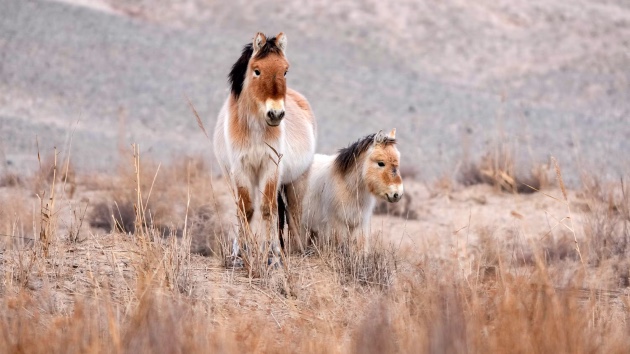
A group of wild horses known as Przewalski’s horses has returned to Central Asia after being driven to near-extinction in the 1960s.
In 2024, several zoos took part in the first stages of the reintroduction of the horses to their native Kazakhstan.
Subsequent efforts brought the Przewalski’s horses to neighboring Mongolia.
Przewalski’s horses are known as the last surviving lineage of true wild horses. Their populations declined as a result of habitat loss, overhunting and hybridization with domestic horses, according to the WWF’s Natural Habitat Adventures.
Countries taking action to protect natural resources
In the U.S., the federal government under the Trump administration has taken several actions that could potentially harm the environment, including granting fossil fuel operations in the Gulf exemption from Endangered Species Act protections; the Senate voted to overturn Biden-era Arctic protections; and the U.S. Department of the Interior reached a nearly $1 billion deal with French energy company, TotalEnergies, to end the company’s offshore wind development.
But other countries are making strides in protecting vast amounts of land and water.
Earlier this year, the High Seas Biodiversity Treaty – aimed to protect 60% of the global ocean that is beyond national jurisdiction – entered into force globally.
Adopted under the United Nations Convention on the Law of the Sea (UNCLOS), the treaty opened for signature in September 2023 and could safeguard marine ecosystems beyond national borders.
In July 2026, Ethiopia launched a national campaign to plant 700 million trees a day, aiming to plant 50 billion trees by the end of 2026.
The I-25 Greenland wildlife overpass near Larkspur in Colorado opened in December 2025. The overpass is the largest in the U.S. and will allow elk, pronghorn, mule deer, black bears, mountain lions and a variety of other species to cross, according to the Colorado Department of Transportation.
Italy will ban the killing of male chicks starting in 2027, ending the deaths of 34 million birds every year. Male chicks are often killed because they cannot produce eggs.
Poland, once the largest fur-producing country in Europe with mink, fox, chinchilla and raccoon dog farms housing around 3.4 million animals, has banned fur farming. The European Union is considering a union-wide ban on fur production.
Copyright © 2026, ABC Audio. All rights reserved.


